 Written by
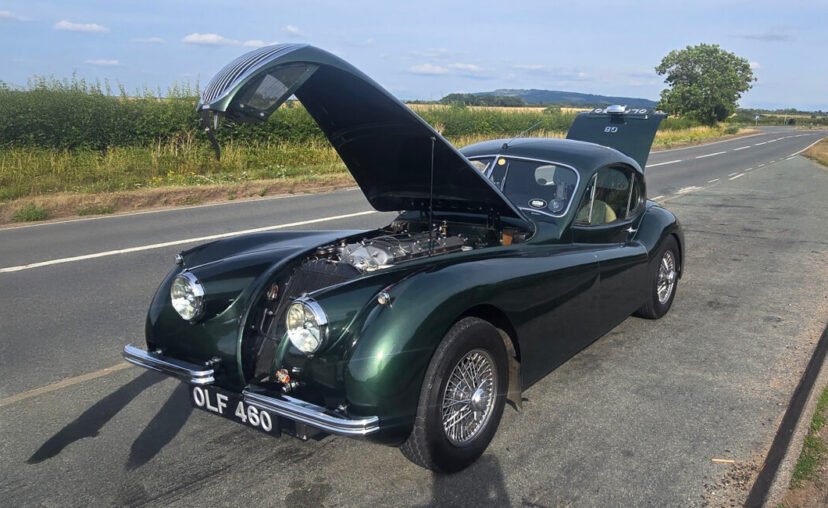
 We have a new member in our collection: a 1954 Jaguar XK120. However, this is not just any XK120; this car is truly special. It was supplied new by Henlys of London to the famous lady racing driver Miss P.M. Burt (Patsy) and was first registered in January 1954.
Patsy Burt was an esteemed racing driver who fought against the inequalities in motorsport—many would say these challenges still exist today. She achieved 42 victories and broke nearly 100 records, becoming one of the most successful British female racing drivers of all time, often seen in her distinctive powder blue racing cars, like the one with license plate XK1120, before its major restoration.
This 1954 Jaguar XK120 was a car dearly cherished by Patsy Burt and stands as an icon of a remarkable period in British motoring history. As one of only 195 right-hand drive examples produced, ‘OLF 460’ is breathtaking to behold.
The late Richard Colton acquired chassis 669108 after considering a Nigel Dawes’ car and even turning down a freshly completed example. He had it transformed into his own version of an uprated XK120 Fixed Head Coupe. This project, overseen by Michael Stewart of Stewart’s Classic Motors—who had achieved numerous concours wins with his own XK120 OTS—took a year to complete (1996-1997).
John Brown of Leaping Cats was responsible for refurbishing the chassis and body. He relocated the engine and gearbox mounts to accommodate rack-and-pinion steering and a tubed XK140-type radiator with closed-circuit cooling. The suspension was enhanced with Leda telescopic rear shock absorbers, competition springs, one-inch diameter torsion bars, and a stiffer anti-roll bar. The brakes and rear axle were upgraded to feature four-wheel discs and a limited-slip differential, respectively. In addition to a Monza-style fuel filler and reprofiled arches (necessitated by the larger 15 x 6J wire wheels), Richard Colton desired for onlookers to be unaware of “all the goodies under the skin.” This magnificent car is finished in green with a cream and green suede leather interior accented by beautiful walnut trim, making it one of the most iconic and evocative classic British sports cars in the country.
Originally, the XK120 was built as a testbed platform to showcase Jaguar’s new XK engine. It received such a positive reception that Jaguar decided to immediately put it into production, making it the fastest production car in the world at the time. The “120” in its name denotes its recorded top speed of 120 mph, although a prototype with a longer gear ratio and a special aerodynamic windscreen recorded an average top speed of 135 mph during a test in Belgium.
This XK120 has undergone several alterations and adjustments that have transformed an already fantastic driver’s car into a truly astounding one. Many cosmetic changes made to later models, which Jaguar implemented, have also been applied to this car. These include reprofiled wheel arches to accommodate 15” wheels and the removal of the beading around the edges, resulting in a sleeker appearance. The cosmetic improvements represent just the tip of the iceberg.
A considerable amount of attention has also come from the experts at Rob Beere Racing, renowned for their Jaguar racing engines. They fitted a 3.8L racing engine featuring a wide array of carefully selected components, including straight-port heads, a lightened flywheel, electronic ignition, forged Accralite pistons, bespoke exhaust manifolds, wide-blade balanced and shot-peened rods, and a high-capacity oil pump and cooler. This culminates in over 260 bhp and 268 ft-lbs of torque.
While the detailed improvements mentioned above have led to remarkable performance, this XK120 is far from the basic racing machine that the under-bonnet upgrades might suggest. The car’s cabin has received significant attention to enhance the practicality, comfort, and overall driving experience.
The most notable change is the substantial improvement in the space and positioning of the driver and passenger seats. This was achieved by first removing the storage bin located behind the seats and in front of the rear bulkhead, and then modifying the shape of the bulkhead behind the driver’s seat. As a result, there is now a much greater range of adjustment for the seating position. Consequently, a driver who is 6 feet tall or more will find the car notably easier to drive compared to a conventional XK120. Although the removal of the storage behind the seats is a trade-off, it has been compensated for by adding an E-Type central armrest and an oddment box between the two seats.
Additionally, the cabin has seen several convenience upgrades, including the installation of a radio and speakers, interior and map-reading lights above the windscreen, separate oil and water temperature gauges, an electronic tachometer, a calibrated speedometer, door-mounted map pockets, a hazard warning light, and an electrical kill-switch.